
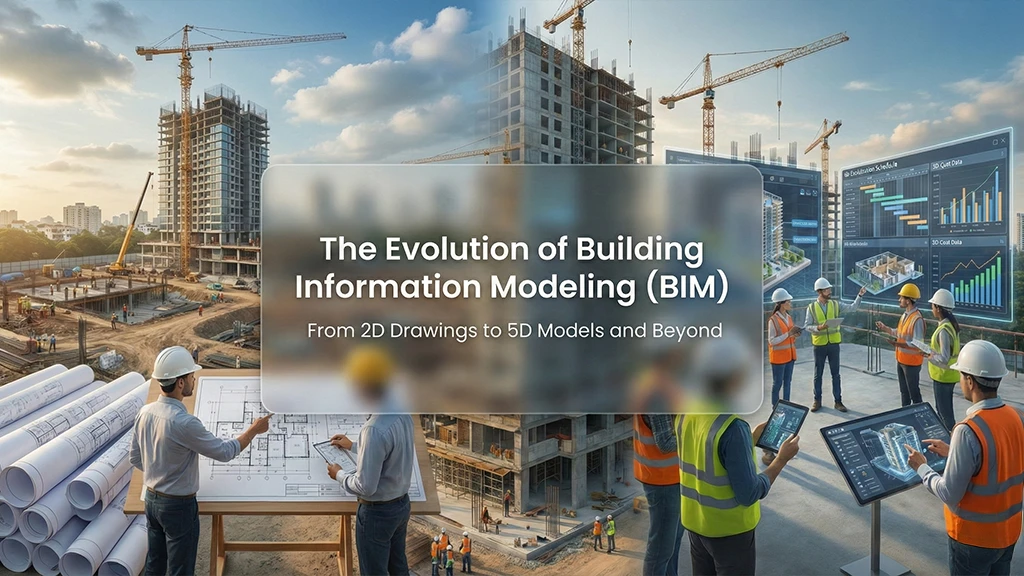
The construction industry has transitioned from using paper-based methods to digital tools, collaborative platforms, and intelligent models during the last three decades. The Building Information Modeling system drives this transformation because it has developed from basic 2D designs to sophisticated 5D models, which improve project accuracy and efficiency and team collaboration throughout all stages of development.


What is BIM Modeling?
Building Information Modeling (BIM) serves as a complete digital model that includes all elements of a building. Here, the system displays all physical aspects of the building together with its materials and operational systems and their lifecycle performance.
The use of BIM services in India has become standard practice for all major projects. At Designheed, BIM technology provides time and cost advantages for different building types, which include office spaces and industrial facilities. The Scan to BIM Services in India provide essential support for the documentation of existing building structures. The process involves scanning buildings to create precise three-dimensional models of their actual appearance.
From 2D Drawings to Digital Modeling
Architects and engineers used 2D drawings as their main design tool throughout history. The project teams of the 1960s and 70s used hand-drafted blueprints, which consumed a lot of time and were prone to various errors.
The industry experienced its first digital revolution when digital 2D CAD drawings became available, significantly improving the precision and workflow efficiency. The introduction of digital screens through AutoCAD software enabled the industry to stop using pen and paper methods in the architectural modeling services in India, which resulted in fewer errors and better project documentation. However, although the first digital drawings enabled architects to create building designs through plans and sections, they faced difficulties in showing spatial relationships and dealing with ongoing project modifications.
The Rise of 3D and a New Era of Visualisation
The introduction of 3D modeling and rendering services brought its first major advancement through its ability to display structures in virtual three-dimensional form instead of using traditional two-dimensional blueprints. Architects and engineers gained the ability to navigate through a model that displayed spatial relationships between different areas while detecting design flaws at an earlier stage. This development transformed the industry.
The 3D model served as the primary information source for the project instead of being used for decorative purposes. The successive development of tools enabled the creation of smartness, which designers used to build their models, which resulted in the establishment of modern building information modeling systems.
The ArchiCAD software, together with Autodesk Revit software, enabled teams to create parametric models that contained detailed data throughout this period. The models functioned as more than visual representations because they established information environments that allowed different fields to work together while providing deeper design understanding and improved early decision-making methods.
Modern BIM: From Visualisation to Collaboration
The adoption of BIM technology resulted in a complete workflow transformation, which began within months of its introduction to various industries. Architects, engineers, and contractors eliminated their practice of using multiple 2D documents, which they kept in different folders, to create their work from one digital platform that provided them with accurate information. The result of this process reduction led to a better understanding while decreasing the need for design changes and eliminating expensive errors that occurred during construction.
The advanced BIM services available today in India and worldwide support project life cycle management from initial design through construction until building operation and maintenance. The complete project lifecycle from design through construction and through operation and maintenance receives support from advanced BIM services, which exist in India and throughout the world. Designheed offers architectural modeling services in India, using BIM software to create detailed 3D modeling and rendering services that show materials, building systems, and performance data.
BIM provides special advantages to MEP engineers. The MEP drawings services in India and MEP 3D modeling services in India deliver coordinated system layouts or the MEP coordination drawings services in India that detect clashes at an early stage to decrease construction errors while enhancing installation efficiency for both contractors and property owners.
Beyond 3D: The Multi-Dimensional World of BIM
The development of BIM technology led professionals to extend their focus beyond spatial modeling. The development of “dimensions” as a BIM concept emerged when additional data layers enriched the fundamental 3D model.
- 3D BIM – Spatial Intelligence: The core element of the BIM system functions as an accurate spatial model, which contains objects that represent walls, doors, HVAC ducts, structural elements, and additional components. The system enables building visualisations in three physical dimensions while providing better team collaboration tools.
- 4D BIM – Time Integration: The model requires time integration to connect construction schedules and sequencing with the three-dimensional representation. The system enables project teams to forecast construction delays, track construction progress, and visualise construction sequencing while creating construction plans before project initiation.
- 5D BIM – Cost Intelligence: The model begins to incorporate cost information at this stage. The 5D BIM framework enables estimators and project managers to automatically extract material quantities, create precise cost predictions, and monitor budget modifications throughout the design development process, which results in better financial forecasting and openness.
The top teams of today need 6D BIM for sustainability studies and 7D BIM for facility management, which integrates energy performance data and operational information and lifecycle assessments into a single model.
BIM Coordination and Clash Detection
BIM provides its most useful advantage because it allows users to identify project conflicts that will occur in the future. The BIM coordination services in India, which include MEP clash detection services in India, detect building system intersections during the initial design phase. The system prevents onsite problems that lead to construction delays while it reduces errors during the construction process.
BIM allows project teams to conduct virtual coordination sessions for system development because it enables them to identify and resolve installation conflicts before construction starts. Modern software tools create an easy and consistent process that helps teams understand their work with complete confidence.
Conclusion
The development of our engineering capabilities has reached the level where we now use 3D Building Information Modeling (BIM) systems, which enable teamwork and enhance decision-making processes while decreasing potential threats. The implementation of BIM services, architectural modeling services in India, and MEP drawings services in India, together with advanced coordination workflows, has enabled the industry to achieve its highest level of operational efficiency and data-driven performance.
BIM technology will advance through its integration of AI digital twins and real-time collaboration features. The evolution of BIM technology will create a built environment system that operates with greater intelligence while achieving faster results and maintaining better durability.
Frequently Asked Questions
Building Information Modeling (BIM) functions as a digital process that produces intelligent 3D models that merge geometric data with complete information. BIM systems allow architects, engineers, and contractors to work together through a common model. This enhances project accuracy, coordination, cost management, and efficiency throughout all phases of the project.
Building Information Modeling (BIM) evolved from 20th-century drafting and 2D CAD into 3D parametric models with rich data. The AEC industry benefits from BIM because it combines design coordination with scheduling, cost management, and asset management, which enhances their collaborative work through data-driven operations.
The Building Information Modeling system uses the term "dimensions" to describe various data types that developers use to enhance their models.
- Architects and engineers utilise 2D BIM to create building plans, which include architectural drawings and technical documents.
- 3D BIM develops a three-dimensional building model that depicts all physical components and interior spaces of the structure to enhance design understanding and work coordination.
- 4D BIM establishes construction timelines through its time-based scheduling system, which operates on a 3D model to enable teams to test their building construction methods and schedule development.
- 5D BIM enables complete project cost management from project initiation to completion by merging cost data with project models, which precisely determine project material requirements.
The combination of these Building Information Modeling dimensions enables project teams to create better designs while decreasing project risks and completing their work in less time.
BIM started as basic 2D CAD drawings and evolved into 3D models, which display building elements, and reached 4D through construction schedule integration and 5D through cost information inclusion. The evolution of these technologies enables project teams to conduct construction simulations while maintaining their budget control and project scheduling abilities, and their design protection and construction feasibility assessment until project completion.