
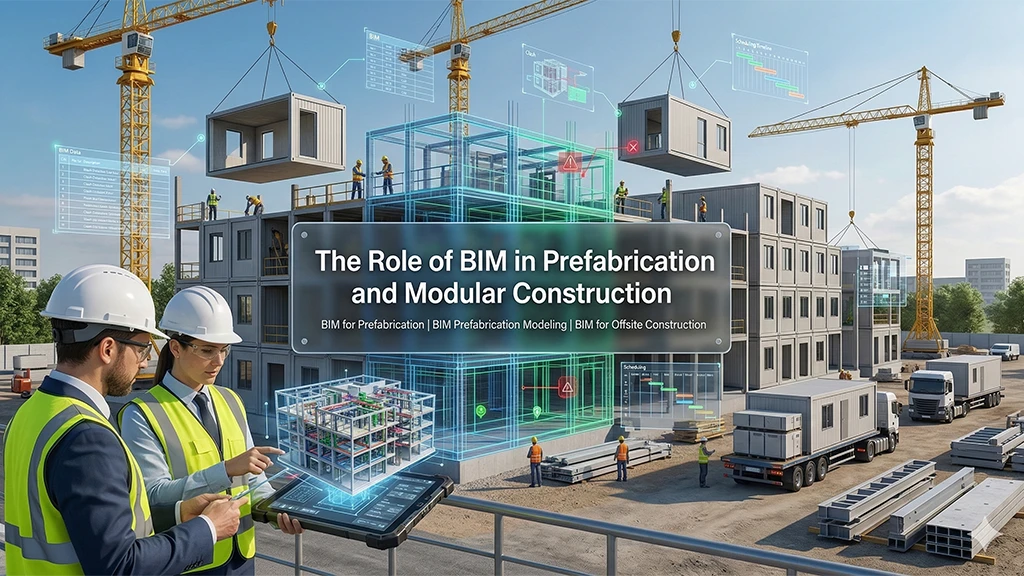
BIM for Prefabrication establishes new construction methods because it allows accurate planning and coordination and manufacturing of components, which will be built off-site. The three services, which include Prefabrication BIM Services, BIM Prefabrication Modeling, and BIM for Modular Construction, help companies to improve their operational processes while decreasing mistakes and finishing projects more quickly. Outlook Designheed provides US AEC companies with dedicated BIM outsourcing solutions to help them execute prefabricated construction projects more effectively.
Table of Contents
- What is BIM Fabrication
- How BIM Facilitates BIM for Prefabrication and Modular Construction
- From Offsite Construction to Precast Projects
- Prefabrication BIM Services and Outsourcing
- Key Differences of the BIM for Prefabrication and Fabrication vs Traditional Method of Construction
- Final Thoughts
- Frequently Asked Questions
What is BIM Fabrication
Building Information Modeling (BIM) for Prefabrication requires designers to use digital 3D modeling and intelligent data systems for the purpose of creating and managing building components, which will be built on-site. The combination of building information modeling with digital workflows enables construction teams to achieve better accuracy and efficiency when they create, visualize, and produce construction materials.
The current market shows that numerous businesses depend on BIM Outsourcing Services, together with Revit BIM Modeling Services, to improve their prefabrication operations while decreasing construction mistakes and speeding up project completion.

How BIM Facilitates BIM for Prefabrication and Modular Construction
BIM functions beyond its capability to create 3D models. The system builds a unified framework that connects spatial design elements with time schedules, material resources, and performance measurements. It supports prefabricated construction and modular building through its various operational components.
- Intelligent Visualization: The Revit BIM Modeling Services, together with the advanced Prefabrication BIM Modeling Services, enable teams to create visual representations of all production components. The process decreases the need for estimation.
- Clash Coordination: Through the BIM system, companies use virtual detection to identify clashes between walls and frames and MEP systems, which decreases on-site conflicts through the BIM Prefabrication in Construction. Expert Clash Detection & Revit Services in USA further support project teams by identifying design conflicts early and improving coordination between architectural, structural, and MEP disciplines.
- Scheduling and Fabrication: The BIM system provides essential information for the BIM Prefabrication Workflow, which enables production to match installation schedules while decreasing lead time requirements.
- Material Optimization: Models with extensive data content generate accurate cutting lists, which help decrease material waste while promoting environmentally friendly practices.
- Better Collaboration: The designers, fabricators, and site teams use cloud-based BIM platforms to share data, which results in their ability to work together through the same data model.

From Offsite Construction to Precast Projects
- BIM for Offsite Construction
Successful offsite construction operations depend on effective project coordination. Outlook Designheed uses BIM for Offsite Construction to create assembly sequence simulations that help check installation procedures before starting the actual construction.
- BIM for Precast Construction
Precast concrete elements combine three characteristics. BIM enables precise 3D modeling of each panel, beam, and column element, which reduces transportation issues and site delays.
- BIM for Industrialized Construction
Industrial construction requires exact measurements for every aspect of the project. The use of BIM for Industrialized Construction enables multiple unit production to maintain the same high standards of quality across all manufactured components.
Prefabrication BIM Services and Outsourcing
AEC companies enter partnerships with providers who deliver Prefabrication BIM Services and Prefabrication BIM Modeling Services to assist their execution of extensive and intricate building projects.
The companies that provide BIM Modeling Services in the USA and BIM Outsourcing Services for US AEC Firms deliver scalable digital solutions that enhance project execution efficiency.
The specialized BIM outsourcing services include:
- Revit BIM Modeling Services
- BIM coordination and clash detection
- BIM Prefabrication Modeling
- Fabrication shop drawings
- Digital workflows for BIM for prefabrication and modularization
The usage of high-quality BIM outsourcing services for the USA enables companies to achieve operational cost reductions while they keep their modeling precision at high levels.
Why Outsource BIM for Prefabrication?
Not every construction firm needs or wants a complete BIM department that operates internally because prefabrication work demands specialized expertise. That’s where BIM Outsourcing Services come in. Here are some of the benefits of outsourcing BIM Prefabrication Services:
- Access to high‑quality BIM outsourcing services for the USA
- The company can increase its workforce during times of high project demand
- Expert coordination from expert BIM consulting firms for prefabrication and modular construction
- The solution provides an economical option for organizations that need specialized expertise without employing full-time staff
Designheed provides customized prefabrication BIM services and BIM Prefabrication Modeling to create comprehensive digital models that represent client designs for fabrication and installation purposes.
Key Differences of the BIM for Prefabrication and Fabrication vs Traditional Method of Construction
| Aspect | Traditional Method of Construction | BIM for Prefabrication and Fabrication |
|---|---|---|
| Design Approach | Primarily relies on 2D or manual planning | Uses BIM for Prefabrication, utilising detailed 3D models developed through tools like Revit BIM Modeling Services. |
| Planning & Coordination | Manual planning and coordination usually happen on-site. | Uses integrated BIM Prefabrication Modeling and clash detection to coordinate structural, architectural, and MEP BIM Prefabrication systems before construction. |
| Construction Method | Most components are built on the construction site. | BIM provides support for three construction methods, which include BIM for Modular Construction, BIM for Offsite Construction, and factory-based building component manufacturing. |
| Accuracy & Precision | Accuracy levels are low in manual measurements and visual inspections. | High precision through BIM-enabled prefabrication and digital fabrication workflows. |
| Risk Management | Due to the construction phase in place, problems usually pop up. | BIM-supported linkage of the model to prefabrication delivery records minimizes schedule durations and site risks for successful projects. |
BIM for Prefabrication and Fabrication enables construction projects to achieve better efficiency and more exact results through digital modeling and off-site manufacturing, while traditional construction methods depend on manual work and require construction site operations, which lead to extended project durations and increased project expenses.
Final Thoughts
The industry has reached its turning point through the transition between BIM for prefabrication and modularization and BIM for prefabrication and fabrication. The industry uses prefabrication as its current operational method because BIM serves as the main technology that drives this practice.
The AEC industry achieves faster project delivery through its adoption of BIM Outsourcing Services and its collaboration with expert BIM consulting firms for prefabrication and modular construction, and its adoption of BIM Prefabrication Workflow. Furthermore, Outlook Designheed provides the advanced BIM solutions and trusted partnership needed to enhance prefabrication operations.
Read More –
Dimension Of BIM
Level Of Development
Explore our projects – https://www.designheed.com/projects/
Questions People Frequently Ask
The method refers to building information modeling, which uses digital models to design, coordinate, and validate prefabricated components before the actual production and installation work begins. The system improves construction accuracy while delivering faster project completion times and minimizing expensive construction mistakes.
Using these services, teams can see all project components during the initial design stage, which allows them to find clashes between pieces more easily. This approach decreases the need for rework while enhancing on-site work efficiency and enabling teams to complete their projects within scheduled timeframes.
General BIM tools enable designers to create documentation, while BIM for Modular Construction enables users to construct standard modules through design and production process links that connect to manufacturing schedules and distribution systems.
Outsourcing to Outlook Designheed, which specializes in the area, allows companies to acquire top-quality evit BIM Modeling Services and prefabrication knowledge without needing to develop their own internal workforce.
The coordination advantages of BIM exist across the entire prefab industry, which includes structural precast elements, MEP assemblies, and modular apartments and industrial units.
The answer is yes. Revit and Navisworks, together with other BIM tools, enable prefabrication operations through their sophisticated clash detection system and their ability to create project schedules and manage data.