
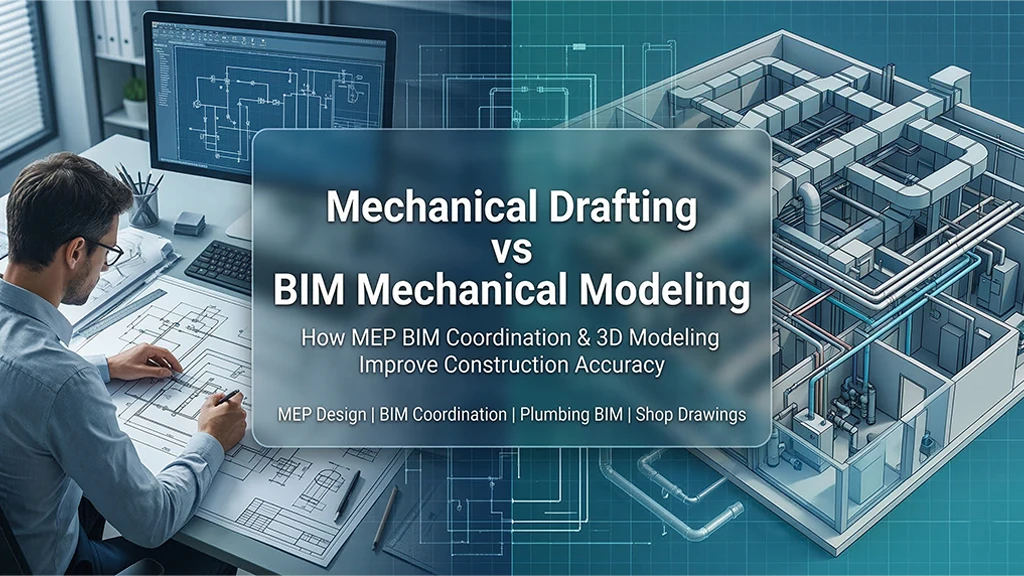
In today’s construction and engineering landscape, selecting the right digital workflow is a strategic business decision. The Mechanical Drafting Services create accurate 2D technical drawings, whereas the Mechanical Modeling and Drawing Services develop complete MEP 3D Modeling Mechanical systems. The teams can improve their work together and handle project timelines and costs with better decision-making abilities through their understanding of project differences.
Table of Contents
- The Core Distinction: Lines vs Logic
- Integration of MEP Design Services
- The Power of MEP BIM Coordination Modelling Services
- From Model to Field: MEP Shop Drawing Services
- Why Choose Designheed for Your Mechanical Needs?
- Comparative Overview: Drafting vs. Modeling
- Key Roles and Benefits of Mechanical Drafting Services
- Wrapping Up
- Questions People Frequently Ask
The Core Distinction: Lines vs Logic
Building Information Modeling (BIM) has replaced traditional drafting methods in the AEC industry, demonstrating how lines create different results than those achieved through architectural design methods. Traditional drafting relies on fixed lines and shapes, which necessitate manual updates with the assistance of mechanical drafting services.
BIM utilizes intelligent objects that contain data about dimensions, materials, and system relationships to create automatic updates, thereby enhancing accuracy. This process holds great importance for MEP design because HVAC systems, piping systems, and electrical systems must work together without issues. MEP 3D modeling enables companies to create three-dimensional visualisations of their systems, while BIM coordination verifies system clashes before construction begins. The MEP shop drawings and plumbing BIM services.

Key Advantages of Logic-Based BIM Modeling
- The intelligent models decrease design documentation errors through their ability to produce more accurate results.
- BIM provides a platform for architectural teams to work together with structural engineers and MEP professionals.
- The design process enables early identification and resolution of system conflicts through its clash detection feature.
- Model changes trigger automatic updates that reflect across all project drawings and scheduling documents.
- The implementation of 3D models enables 3D visual demonstration of complex building systems.
Key Deliverables in Mechanical Drafting
- The creation of precise 2D mechanical drawings
- The production of assembly drawings and fabrication drawings
- The development of equipment installation drawings
- The creation of piping and instrumentation diagrams (P&ID)
- The creation of dimensioning, tolerances, and annotations
- The creation of manufacturing documentation
Integration of MEP Design Services
Modern MEP design services use 3D mechanical systems modeling to assess building spatial restrictions before construction work starts. which goes beyond their basic schematic design capabilities. The approach provides distinct benefits that replace traditional drafting methods through the following advantages:
- Spatial Accuracy:Engineers use precise spatial visualization tools to display HVAC ductwork, plumbing lines, and electrical conduits within restricted wall and ceiling areas, which helps prevent clashes and produces effective designs.
- Data Intelligence: Model components contain built-in metadata, including part numbers, flow rates, and maintenance schedules, which provide operational data that static 2D drawings cannot display.
Design integration through this system enhances design coordination, yielding better construction results and reducing expensive rework activities.

The Power of MEP BIM Coordination Modelling Services
The most significant benefit that MEP BIM coordination modeling services provide is the capability for businesses to detect clashes. BIM technology identifies conflicts at an earlier stage than 2D drawings, which fail to show whether a domestic water line intersects with a structural beam or exhaust duct.
Designheed utilizes specialized software to provide MEP BIM coordination modeling services and performs interference checks through its advanced capabilities. The modelling services enable Designheed to identify “clashes,” which allows the company to save clients thousands of dollars in “rip-and-replace” costs. The industry now chooses BIM Modelling companies like Designheed as their preferred option for complex MEP projects because its predictive features help teams improve their coordination and decrease errors while they work through construction processes
From Model to Field: MEP Shop Drawing Services
The MEP Shop Drawing Services link design models to on-site installation work, ensuring that construction activities proceed according to established design specifications. The service offers multiple advantages, which include:
- Clear 2D Guidance: Installers receive easy-to-understand 2D instructions derived from the 3D model, available in both print and digital formats.
- BIM-Based Accuracy: Shop drawings are extracted directly from the BIM model, which reduces errors that occur in traditional drafting methods that require starting from an empty framework.
- Coordination with Structural Constraints: The layouts establish required designs that exist together with current building restrictions to avoid installation conflicts.
- Plumbing & HVAC Precision: Foremen receive complete Plumbing BIM and HVAC designs, enabling them to perform their tasks with precision and optimal efficiency.
The process establishes a continuous flow from design work to actual building, as it helps projects transition from their design phase to the construction phase while providing better efficiency, error reduction, and time cost savings.
Why Choose Designheed for Your Mechanical Needs?
Designheed delivers more than just drawings; we provide complete construction solutions. The Revit BIM modeling services that we offer create optimal mechanical system performance through three essential factors:
- Performance: The system requires HVAC, plumbing, and electrical components to operate at their highest efficiency.
- Cost Efficiency: The system achieves cost savings through detailed planning, clash detection, and layout optimization.
- Installation Simplicity: The system simplifies complex designs by creating shop drawings that field workers can easily use.
Our approach combines advanced engineering design with practical construction methods to deliver precise results that decrease risks and enhance return on investment. DesignHeed delivers complete project execution through its services, which range from basic permit submissions to complete MEP 3D model coordination, ensuring projects stay on track for timely and budget-compliant completion.
Comparative Overview: Drafting vs. Modeling
Building Information Modeling (BIM) and 3D modeling technologies yield better construction results through their ability to display building designs, provide intelligent building data, and enable designers to work together more efficiently than traditional drafting methods.
| Feature | Mechanical Drafting (2D) | Mechanical Modeling (3D BIM) |
|---|---|---|
| Representation | Uses 2D lines and shapes to depict building elements. | Uses intelligent 3D objects with embedded data. |
| Change Management | Manually update every sheet | Automatic updates propagate across the model. |
| Coordination | Separate drawings for each system; risk of conflicts. | Integrated multi-system coordination (MEP, structural, architectural). |
| Data Intelligence | Limited to what can be shown on paper. Lines and text only. | Contains metadata such as dimensions, materials, part numbers, and flow rates. |
| Clash Detection | Clashes are often discovered on-site. | Built-in interference checks identify clashes before construction. |
| Field Guidance | Requires interpretation from 2D drawings. | Generates accurate shop drawings and installation-ready outputs. |
| Efficiency & Cost | Higher risk of errors and rework. | Reduces errors, rework, and project costs. |
Key Roles and Benefits of Mechanical Drafting Services
The Key Roles and Benefits of Mechanical Drafting Services Work Together to Provide Essential Support for AEC and MEP Industries. The services deliver precise technical documents that support current operational processes, including BIM modeling. They provide two main functions that deliver multiple advantages to their customers.
Key Roles of Mechanical Drafting Services
- Technical Documentation – Prepare precise drawings for HVAC, plumbing, and mechanical systems, ensuring designs are clearly communicated.
- Design Support – Engineers receive assistance from the team to create layout designs, which include both schematics and fabrication-ready designs.
- Integration with BIM – All Revit BIM modeling Services depend on this system, which converts two-dimensional drawings into three-dimensional intelligent models.
- Coordination Assistance – The MEP BIM Coordination modeling services utilize accurate mechanical system representations that the team produces to assist with clash detection.
- Compliance and Standards – The team ensures that all mechanical systems are designed in accordance with both industry standards and safety regulations, as well as project codes.
Benefits of Mechanical Drafting Services
- Accuracy and Precision – The system produces accurate drawings that contain all necessary dimensions and details, minimizing errors.
- Time and Cost Efficiency – The system improves design-to-construction processes, resulting in faster project completion and lower expenses.
- Enhanced Collaboration – The system enables architects, engineers, and contractors to communicate with each other without interruptions.
- Support for Fabrication – MEP Shop Drawing services enable mechanical drafting to create documents that contain all details needed for installation.
- Scalability for Complex Projects – The MEP 3D Modeling Mechanical systems enables modeling teams to create models of extensive mechanical systems, which include all plumbing components.
Designheed utilizes mechanical drafting services as its central element, which supports all digital solutions that help clients transition from 2D drawing methods.
Wrapping Up
The transition from traditional drafting methods to integrated mechanical modeling systems creates a construction process that delivers both visible results and budget-friendly solutions. The combination of Revit BIM modeling, MEP coordination, and shop drawing services eliminates project conflicts while decreasing material waste and preventing construction delays.
Designheed enables projects to transition from design to installation while achieving precise results, faster project completion, and better mechanical system efficiency.
Learn More –
BIM Modeling, Clash Detection & Revit Services in USA
Questions People Frequently Ask
Revit BIM modelling Services provide two key advantages when compared to CAD drafting services. The parametric modeling system of Revit enables designers to create models that maintain interconnections between all design parts. The system provides greater accuracy and enhanced visualization, together with capabilities for executing energy assessments and automated material quantity evaluations, which 2D CAD systems cannot deliver.
The MEP BIM Coordination modeling services create cost reductions for projects through their ability to streamline building information modeling processes. The digital model allows you to solve "clashes" (spatial conflicts), which helps decrease emergency on-site redesigns and also cuts down material waste and worker downtime. The process of moving a virtual pipe costs less than the process of moving a physical pipe.
DesignHeed provides Plumbing BIM services that use advanced plumbing modeling capabilities. Our Plumbing BIM services provide comprehensive system modeling, encompassing waste systems, vent systems, and water systems, while maintaining slope precision and ensuring the coordination of structural elements to ensure the proper functioning of gravity-driven systems.
Contractors require MEP Shop Drawing services because they need the exact fabrication and installation measurements, which shop drawings provide. The accuracy of 3D model-derived drawings exceeds that of traditional drafting because 3D models provide better results for drawing creation.
BIM exists exclusively for use in large commercial construction projects. The decreasing software costs, together with material procurement benefits, make BIM essential for residential and industrial projects that fall between small and large project sizes.