
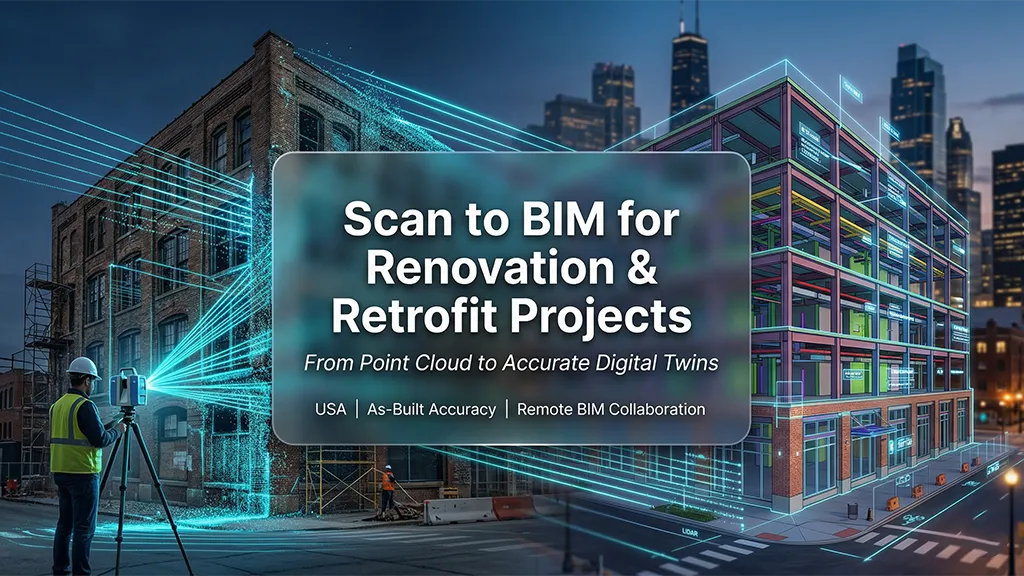
The process of transforming laser scans into Revit-based as-built models enables remote collaboration while reducing costs and supporting retrofit work. In the construction industry, the Scan to BIM service in the USA transforms point cloud data into exact digital models, which architects use to renovate historical buildings throughout the United States. Companies outsource laser scan to BIM services from outsourcing companies like Designheed that enable faster project delivery while creating more accurate results and producing dependable digital twins used for renovation work and facility management.
Table of Contents
-
- The Future of Retrofits: Why Scan to BIM Dominates the USA Market
- The Precision Gap: Challenges of As-Built Accuracy in Older US Buildings
- From Point Cloud to Revit: the Modern Workflow
- Why US Firms are Choosing to Outsource Laser Scan to BIM Services
- Why is Scan to BIM So Crucial for Renovation and Retrofit Projects?
- Why Designheed is the best choice for Scan to BIM Modeling Services in USA
- Conclusion
- Questions People Frequently Ask
The Future of Retrofits: Why Scan to BIM Dominates the USA Market
The implementation of Scan to BIM creates accurate as-built documentation, which drives efficient renovation processes for retrofitting projects throughout the United States. As companies increasingly seek outsourced laser scanning services for their conversion to building information modeling work, US businesses depend on Scan to BIM Revit services to transform point cloud data into functional intelligent models.
The technology enables precise As-Built 3D scans to BIM Revit models and Scans to Digital Twins because it operates from Point Cloud Scan to BIM in the USA to 3D scan to BIM in the US. Companies like Designheed use Scan to BIM Services USA to create their top-level products.
The Remote Scan to BIM Support system provided by Designheed provides the USA Firms with efficient collaboration tools which establish Scan to BIM as a fundamental element for developing affordable, sustainable retrofitting solutions.
The Precision Gap: Challenges of As-Built Accuracy in Older US Buildings
The United States contains a large stockpile of old infrastructure that needs to be repaired. However, the older buildings across the USA lack reliable documentation that creates a significant gap between the original plans and the buildings’ current conditions. The main problem that architects face in their work exists when they need to create accurate architectural documentation for both 1920s warehouse restorations and 1970s hospital modernizations. Thus, to ensure accuracy, construction companies drive the demand for outsourced laser scanning to BIM services and scan to BIM Revit services in the USA.
Traditional surveying methods often miss:
- Structural Deflections: Floors that aren’t quite level or walls that have bowed over time.
- Hidden MEP Layers: Decades of electrical and plumbing “patches” that were never recorded.
- Complex Geometries: Historic cornices or non-standard structural joints that are impossible to capture in 2D.
The process of capturing building details requires teams to convert As-Built 3D scans to BIM Revit models and support Scans to Digital Twins for better visualization. Through the work with a “Single Source of Truth” instead of making guesses about their information, firms can reduce errors and rework, making Scan to BIM in the US essential for accurate retrofit planning.

From Point Cloud to Revit: the Modern Workflow
The US presents contemporary retrofit initiatives that depend on the advanced Scan to BIM method to transform unprocessed scanning information into interactive virtual models. Through Designheed, the method of Point Cloud Scan to BIM in the USA transforms laser scanning data into precise digital models that represent current building conditions through proper scanning and database alignment.
With designheed scan to BIM Revit services in the USA and 3D scan to BIM in the US, professionals use point clouds to create complete As-Built 3D scans to BIM Revit models, which help Scans to Digital Twins.
Designheed provides Scan to BIM Modeling Services in the USA, together with their outsourced laser scan to BIM services, enabling faster execution of project schedules. The USA companies that use Remote Scan to BIM Support achieve better cooperative work, which makes Scan to BIM in the US essential for their current operational processes.
Key Workflow Steps:
- Data Capture: Our team employs 3D LiDAR scanners to gather multiple data points, which result in a Point Cloud Scan to BIM for US locations.
- Processing & Registration: The “points” are connected to form a complete 3D representation of the surrounding area.
- Modeling in Revit: This is where the magic happens. Our USA scan to BIM Revit services use point cloud data to create intelligent objects, which include walls, pipes, beams, and conduits.
- Validation: The final Revit model is overlaid against the original point cloud to ensure 100% fidelity.
Key Benefits:
- Delivers enhanced precision for intricate renovation projects.
- Decreases human mistakes while increasing productivity.
- Enables quicker completion of projects.
- Enables better teamwork for teams working from different locations.
- Data-rich models enable superior decision-making capabilities.
Why US Firms are Choosing to Outsource Laser Scan to BIM Services
The increasing demand for Scan to BIM Modeling Services in the USA is outstripping the local supply of in-house talent. The process of modeling from a point cloud requires specialized expertise as it involves extracting meaningful information from complicated “noisy” data sets rather than performing basic drafting tasks.
Many leading AEC firms now opt to outsource laser scan to BIM services to partners like Designheed. This allows them to:
- Scale Rapidly – Rapidly Scale their operations, which enables them to manage extensive retrofit projects without requiring additional modeler staff.
- Access Expertise – Leverage teams that specialize specifically in Remote Scan to BIM Support for USA Firms, ensuring ISO-compliant workflows.
- Reduce Overhead Cost – The company will achieve financial savings through reduced operational expenses, which result from avoiding expenses associated with specialized equipment and software license costs.

Why is Scan to BIM So Crucial for Renovation and Retrofit Projects?
Old buildings, unrecorded changes, and obsolete building methods create particular difficulties for renovation and retrofit work in the United States. Building designers encounter difficulties during the planning process because existing traditional drawings do not show the current state of the building. This is where Scan to BIM in the US becomes essential.
Using Point Cloud Scan to BIM in the USA and 3D scan to BIM in US teams can create an exact building model of existing buildings through their scanning technology. The As-Built 3D scans convert into BIM Revit models, which customers use for accurate building design modeling. The building digital representation from Scan to BIM Services USA and Scan to BIM Modeling Services in the USA helps construction projects decrease their mistakes, rework activities, and expensive project delays.
Key Advantages of Scan to BIM for Renovation & Retrofit Projects:
- High Accuracy: The system measures complete building dimensions for historic structures and complicated buildings.
- Improved Planning: USA design and execution needs to obtain an exact scan to the BIM Revit service through this system.
- Digital Twins: Scans create Digital Twins, which enable future facility management and simulation purposes.
- Error Reduction: The system decreases both inconsistencies and expensive reconstruction work.
- Remote Collaboration: USA companies can conduct distant Scan to BIM Support operations through this solution, which enables their teams based in different locations to work together.
- Time & Cost Efficiency: The solution automates operational processes while decreasing the need for physical measurement work.
- Outsourcing Flexibility: The availability of laser scan to BIM services lets businesses delegate work to specialists who will manage their point cloud to model operations.
Scan to BIM in the US functions as a vital connection between existing conditions and design intent, which provides accurate outcomes, effective processes, and better project management throughout all stages of renovation work.
Why Designheed is the best choice for Scan to BIM Modeling Services in USA
Designheed provides accurate Scan to BIM Services USA, which transforms Point Cloud Scan to BIM and 3D scan to BIM to create precise As-Built 3D scans to BIM Revit models.
Why Choose Designheed:
- Experts deliver scan to BIM Revit services to customers throughout the USA who need assistance with their complex and historical buildings.
- Enables users to create digital twins from their scans, which they can use for both visualization and simulation purposes.
- Provides USA firms with the ability to conduct remote Scan to BIM operations through their services.
- Manages outsourced laser scan to BIM operations through its effective service delivery system.
- Achieves time savings and error reduction, which leads to faster project completion.
Designheed provides the United States with renovation and retrofit projects with dependable yet affordable and precise BIM modeling services.
Conclusion
The process of renovating and retrofitting existing buildings in the United States is now undergoing a transformative change through the implementation of Scan to BIM technology. Scan to BIM delivers a complete solution for handling outdated or incomplete as-built documentation through its combination of precise point cloud data, advanced Revit modeling capabilities, and its digital twin creation feature.
The practice of outsourcing Scan to BIM services enables companies to achieve both time and cost reductions while they gain access to industry-leading expertise and advanced technological solutions.
U. S. construction companies can proceed with their renovation and retrofit work because advanced workflows help them obtain the most current and precise operational data.
Questions People Frequently Ask
The standard processing period for Scan to BIM Services depends on the particular project requirements, which need to be evaluated first. The typical duration of a scanning project for a 50,000 square foot commercial building takes between two and four weeks until the Revit model reaches its finished state.
For most renovation projects, LOD 300 is the sweet spot, providing accurate geometry for structural and architectural elements. Complex MEP retrofits require either LOD 350 or LOD 400 to achieve fabrication-level detail.
The cost of Scan to BIM services depends on three main factors, which include project complexity, building size, and software selection. The standard pricing method requires you to pay either based on the building's square footage or the number of point cloud scans. The practice of outsourcing these services proves to be more economical when compared to conducting them through internal resources.
Historical buildings and older structures represent the perfect application of Scan to BIM technology. The system allows professionals to collect accurate data when no as-built drawings exist. The system enables renovation projects to proceed while maintaining the building's original design.