
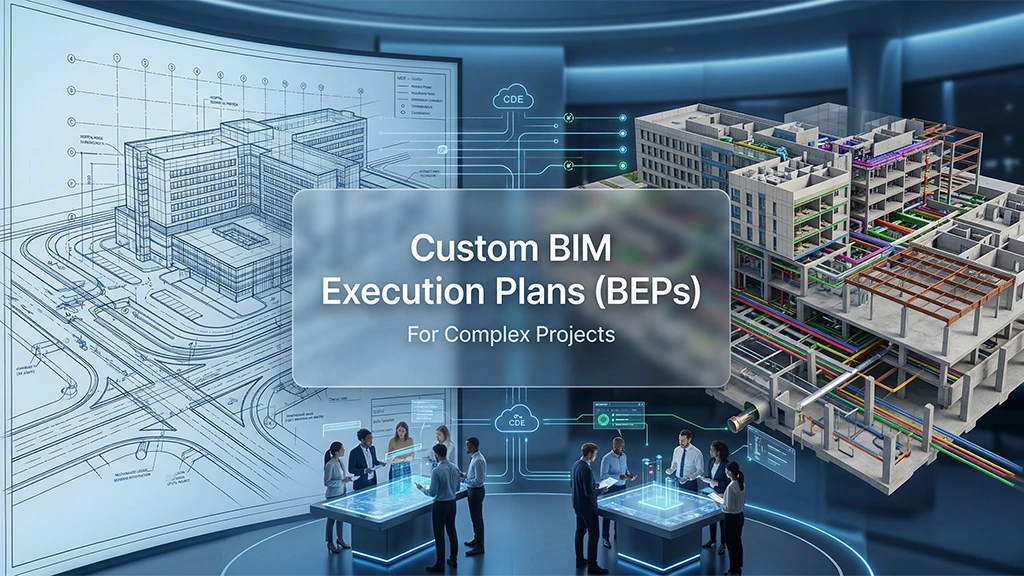
In 2026, the architectural engineering and construction industry demonstrates a rapidly evolving construction process that requires more than strong steel and high-quality concrete for multi-million-dollar projects to succeed. As projects develop extensively, it becomes necessary for sprawling healthcare campuses or high-speed rail networks to establish the need for BIM services, which determines the difference between a seamless delivery and a logistical nightmare.
Designheed demonstrates its recognition that BIM systems need customized solutions instead of using standard systems. The construction industry now relies on specialized BIM execution plan services in the USA because companies need to manage their digital systems across multiple project stakeholders.
Table of Contents
- Introduction About ISO and ISO 19650
- Why is ISO 19650 Important in Construction
- How ISO 19650 Works in Practice
- Role of BIM Services in the ISO 19650 Implementation
- Overview of the ISO 19650 Series: A Strategic Framework for Modern Construction
- How Designheed Enables ISO 19650 Implementation
- Conclusion
- Frequently Asked Questions
Why a Custom BEP Non-Negotiable for Complex Projects?
A custom Building Information Modeling Execution Plan (BEP) is non-negotiable for complex projects, as the high-stakes constructions require unique data that addresses the specific risks and multidisciplinary coordination, not the one-size-fits-all approach. In complex projects, a tailored BEP becomes essential to align stakeholders, guarantee effective risk management, and ensure that the project is meticulously executed with greater precision.
Here are some of the reasons why tailored BEP development for complex projects is no longer an option but a critical requirement for success:
- Aligning complex stakeholders – The process of managing complex stakeholder requirements requires multiple teams to work together to achieve their separate goals. The specific needs of each project require the creation of a custom BIM execution plan, which establishes standard operating procedures for all project stakeholders. The development of building execution plans requires special attention because any misalignment in complex project development will result in expensive project setbacks.From
- Structured BIM Project Execution Planning– BIM project execution planning needs to create a model development, team collaboration, and data sharing roadmap. BIM execution plan services in the USA help project teams to develop standard operating procedures that match their project needs while maintaining effective collaboration from design through construction.
- Compliance with Industry Standards – ISO 19650 compliance serves as a fundamental requirement that organizations must meet to ensure their operations will achieve both consistent performance and high-quality results. The ISO 19650 BIM compliance services in the US enable organizations to verify their BEP compliance with international best practices, which require structured information management and secure data sharing through the common data environment BIM USA.
- Clear Definition of LOD and Deliverables – Complex projects require experts to establish precise guidelines for both model details and project results. The custom BEP establishes USA requirements for BIM LOD standards while it defines the expected delivery schedule for BIM assets, which will provide stakeholders with correct and usable information throughout the project. The process reduces unnecessary work while enabling efficient progress between different project stages.
- Enhanced Coordination and Clash Detection – Coordination difficulties increase when project work becomes more complicated. The customized BIM execution plan includes a complete BIM clash detection coordination plan, together with specialized BIM coordination plans for hospital systems and infrastructure systems. The system enables early detection of design conflicts, which leads to their resolution before construction work starts.
- Strong Information Management Framework – BIM relies on data as its fundamental element. A custom BEP integrates a comprehensive BIM information management plan, AEC, which ensures that all information can be accessed and used reliably. The process helps organisations to make better decisions and maintain their assets over time.
Key Components of a Custom BEP
- BIM LOD Requirements USA: We define the Level of Development (LOD) for every phase, from LOD 100 (conceptual) to LOD 500 (as-built/operational).
- BIM Information Management Plan AEC: This document establishes data naming rules and classification standards, which include OmniClass and Uniclass, and metadata requirements.
- BIM Deliverables Handover USA: We transfer our files to customers while maintaining a complete transition to Facility Management through our work with the Asset Information Model.
The Role of Designheed in BEP Development
When it comes to delivering reliable BEP BIM services in the United States, Designheed stands out as a trusted partner. Their expertise in BIM execution plan services in the USA ensures that each BEP is tailored to project-specific needs.
Designheed centers its business activities on three core service areas, which include:
- Customized post-contract BEP development for complex projects
- Advanced coordination workflows
- Compliance with ISO standards
- Scalable solutions for complex infrastructure and healthcare projects
The clients experience three advantages, which include better operational performance, decreased mistake rates, and improved project results.

How Designheed Adds Strategic Value
- Automated Clash Detection: The system identifies both “hard” clashes and actual workflow and clearance conflicts.
- 4D & 5D Integration: The system connects BEP data with construction timelines and financial projections.
- Compliance Audits: The team conducts regular checks to verify its compliance with ISO 19650 BIM US compliance standards.
Steps to Develop a Custom BEP
A successful BEP requires an organized approach to its development process. Here is an explanation of the fundamental procedures that need to be followed.
Step 1: Define BIM Goals
Project goals need to be established first, together with the identification of BIM applications, which will include visualization, coordination, and facility management.
Step 2: Establish Standards and Protocols
The organization must achieve BIM compliance according to ISO 19650 standards while establishing rules for naming files, selecting file types, and creating operational procedures.
Step 3: Develop Coordination Strategy
The team needs to develop a comprehensive BIM clash detection coordination strategy, which will help them find and solve conflicts before they become major problems.
Step 4: Set Up the CDE
The organization needs to implement a common data environment system for BIM project data management purposes.
Step 5: Define LOD and Deliverables
The project requires USA-based organizations to define their BIM LOD needs together with their expected project results at every development stage.
Step 6: Monitor and Update the BEP
The BEP functions as a dynamic document that requires updates throughout every stage of the project.

Benefits of a Custom BIM Execution Plan
The implementation of a specialized BIM execution plan provides organizations with tangible benefits, which are most evident when they handle their complex high-value projects.
- Improved Collaboration – Teams maintain their operational harmony through established work processes that support their communication needs in BIM project execution planning.
- Reduced Errors – The structured BIM clash detection coordination plan enables teams to detect conflicts during the initial stages, which results in lower expenses for rework.
- Enhanced Efficiency– The organization of processes through a properly controlled common data environment, the BIM USA system leads to better use of time and resources, together with faster project completion.
- Regulatory Compliance – The ISO 19650 BIM compliance services in the US establish standards that protect the consistency of data while holding organizations responsible for maintaining data security.
- Better Project Outcomes – USA organizations use defined BIM LOD requirements together with structured BIM deliverables to achieve precise data transfer, which supports decision-making throughout all project stages.
The organizations that spend on BIM execution plan services in the USA, while hiring a BIM execution plan consultant in the USA, can develop a competitive edge, which allows them to deliver projects with enhanced accuracy and sustainable value.
Conclusion
The AEC industry requires organizations to create customized BIM execution plans that enable them to execute complex projects successfully according to ISO 19650 requirements. The project achieves success through a well-structured BEP, which enables compliance with ISO 19650 BIM compliance services in the US and facilitates workflow management through a shared data environment, BIM USA.
The BEP operates as a document that functions with a strategic purpose to foster teamwork and drive innovation and operational excellence. Designheed assists organizations in achieving their complete BIM capacity through risk reduction and budget-friendly project delivery.
Frequently Asked Questions
What is the primary difference between a pre-contract and post-contract BEP?
The pre-contract BEP is a proposal that outlines the team’s capability to meet the client’s requirements. The post-contract BEP is a detailed operational document that lists specific workflows, software versions, and delivery dates.
Why do complex projects need a BIM execution plan consultant in the USA?
The project requires involvement from more than 100 people. Designheed functions as an impartial coordinator who verifies compliance with technical standards across multiple software systems while enforcing the implementation of the BIM clash detection coordination plan.
How does ISO 19650 affect BEP development in 2026?
The 2026 ISO 19650 standard requires Building Execution Plans to demonstrate their building project requirements throughout all operational phases of the building lifecycle. The standard requires Building Execution Plans to track building project data from its first design phase through to its final operational stage.
What industries benefit from BEP modeling?
The development of Building Energy Performance (BEP) systems provides advantages to multiple industries that exist beyond their core applications. The healthcare industry and the infrastructure industry derive substantial advantages from customized Building Information Modeling (BIM) coordination plans, which extend to both hospital facilities and infrastructure projects.
How does BIM improve project coordination?
BIM enhances project coordination through its ability to create organized workflows, which include BIM clash detection and coordination plans. The system helps to discover and solve conflicts that would otherwise become construction problems.