
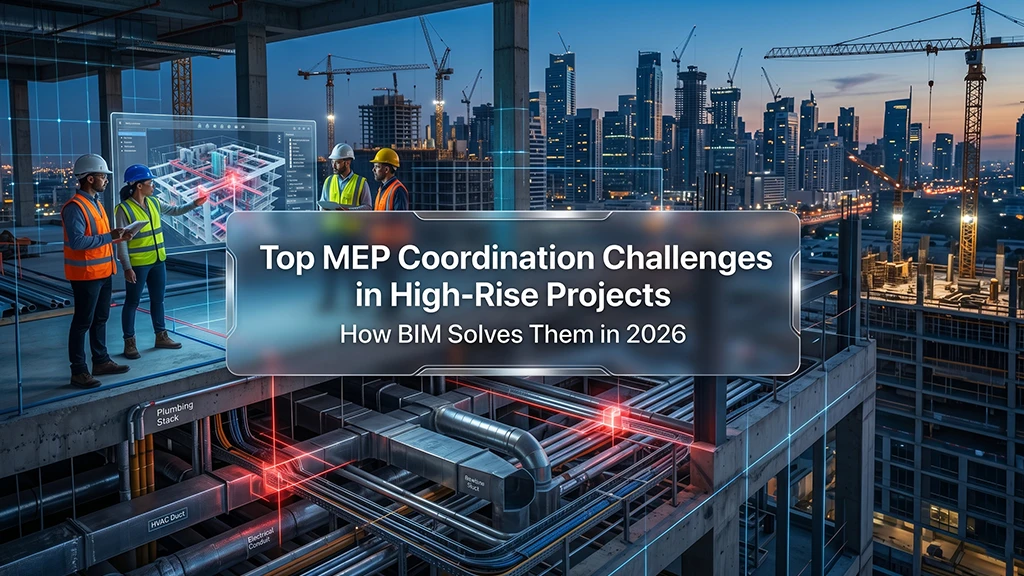
High-rise projects in 2026 face major MEP coordination issues like clashes, design inefficiencies, and compliance errors. The combination of BIM-driven MEP drafting and design services with Revit shop drawings and clash detection systems creates more efficient workflows while improving precision. Mid-rise buildings increasingly adopt BIM MEP for efficiency, while Designheed delivers reliable MEP coordination and NBC compliance solutions across diverse project needs.
Top 7 Major MEP Coordination Challenges in High-Rise Projects
The growing complexity of urban skylines, which reach higher heights in 2026, has made MEP coordination the most vital component for successful high-rise building projects. The Mechanical, Electrical, and Plumbing systems must achieve complete spatial integration, which creates both coordination difficulties and vital design requirements.
The seven major MEP coordination problems, along with the solutions that Building Information Modeling (BIM) technology provides, are:
- Spatial Clashes Between Systems – High-rise buildings require extensive duct, pipe, and cable tray systems throughout their construction. The traditional method of using 2D drawings fails to show overlapping elements until later stages.
BIM Solution – The advanced MEP clash detection system of BIM Solution detects design conflicts at their initial stage to prevent expensive project delays and rework.
2. Inefficient Communication Across Teams – Architects, structural engineers, MEP consultants, and contractors use different tools, file versions, and communication channels, but their separate operations create coordination problems in high-rise projects. Additionally, it can also result in incorrect drawings, postponed decisions, and expensive rework at the construction site. The rise of project complexity means that even the slightest communication breakdowns will result in extensive coordination problems.
BIM Solution – The centralized BIM environment provides one accurate information source, which enables all parties to work together simultaneously. Teams can work with shared cloud-based models, which enable them to access design updates, monitor changes, and spot conflicts during the design process. The integrated workflow system enhances communication between teams, decreases mistakes, and promotes better MEP coordination throughout all stages of the project.
3. Complex Design Modification – High-rise projects experience complete MEP system disruptions when clients make design changes, regulatory authorities update their requirements, and site conditions create obstacles during the post-design phase. A small adjustment in one discipline usually creates multiple service impacts, which lead to layout discrepancies and coordination problems and schedule interruptions that require proper management to avoid.
BIM Solution – BIM enables fast and reliable updates through parametric modeling, which makes all model elements react to changes in any single component. This process ensures the MEP systems maintain full system integration and operational coherence. The synchronized updates to drawings and documentation enable design teams to execute design changes while they reduce potential errors and achieve consistent results throughout all MEP coordination deliverables.
4. Limited Visualisation – Architectural designs for high-rise buildings use conventional 2D MEP CAD drawings, which fail to show the intricate details of their mechanical systems. Teams encounter difficulties in understanding duct, pipe, and cable tray connections because they lack complete spatial information about these systems.
BIM Solution – BIM enables stakeholders to visualize and simulate building systems through its intelligent 3D visualization technology, which shows complete integration and operation of all MEP systems within the structure. This clarity improves decision-making, enhances coordination, and helps installation teams execute with greater precision, reducing costly rework and delays.
5. Compliance Challenges– The National Building Code of India (NBC) creates challenges for high-rise projects because it requires MEP systems to undergo complete design and review processes. The project faces three major risks because the current workflows operate without proper connections between different tasks.
BIM Solution – The BIM system creates complete compliance verification processes through its ability to include code requirements into the model framework. The system enables teams to assess their designs against NBC standards because it provides real-time validation, which ensures consistency throughout all MEP systems. The process results in efficient approval procedures that decrease risks while delivering dependable MEP coordination services that meet compliance standards.
6. Poor Documentation – Fast-paced high-rise projects experience major onsite confusion because MEP shop drawings in Revit services contain incomplete, outdated, or inconsistent information. Different teams working with different drawing sets will create installation errors, which lead to project delays and expensive rework costs that decrease project quality and extend project timelines.
BIM Solution – Autodesk Revit provides MEP shop drawings that deliver precise and synchronized documentation that reflects current information. The BIM system draws its building design drawings from the central model, which automatically updates all sheets whenever design changes occur. The system produces clear construction-ready documents that improve site execution while decreasing errors and boosting overall project productivity.
7. Cost Overruns and Delays – In high-rise construction, even minor coordination errors between MEP systems can escalate into significant budget overruns and schedule delays. The project suffers from two main issues, which include unidentified clashes and design inconsistencies that require rework to resolve.
BIM Solution – BIM allows construction teams to detect clashes at the beginning of a project while validating design elements for all building systems. The construction teams that identify conflicts before starting construction work create a process that minimizes wasteful material usage while they improve project timelines. The system enables better cost management, together with quicker project completion times and more reliable project outcomes.

Why Mid-Rise Buildings in Tier-2 Cities Are Switching to BIM MEP in 2026
High-rise buildings create urban landscapes for metro cities while mid-rise developments continue to grow in Tier-2 cities. Developers use BIM MEP technology for their mid-rise projects because it helps them maintain their industry competitiveness and operational efficiency.
Key Reasons for the Shift:
- Cost Optimization – BIM technology decreases project expenses through its ability to diminish errors and reduce the need for MEP work during mid-rise construction projects.
- Faster Project Delivery – The combination of streamlined workflows together with automated clash detection leads to substantial reductions in project completion timelines.
- Improved Quality – Revit MEP shop drawings services deliver accurate measurements, which result in enhanced installation processes.
- Scalability – BIM MEP in mid-rise projects benefits from flexible BIM models that adapt to changing design needs.
- Better Coordination – The MEP coordination drawings services facilitate efficient system integration for all development sizes.
- Skilled Workforce Adoption – The number of BIM-trained workers in tier-2 cities has increased, which improves the process of implementing BIM technology.
Designheed supports this transition by providing MEP CAD drafting services and BIM-based coordination solutions that meet the specific needs of mid-rise building projects.
NBC 2016 Compliance for MEP Services: Common Mistakes & Easy Fixes
Compliance with the building codes is crucial and must be followed because they ensure both safety and the building approval process. The National Building Code of India 2016 establishes Indian building standards that face the same compliance difficulties found in the United States that apply to MEP systems.
Common Mistakes:
- Incomplete Code Integration Designs often overlook specific compliance requirements during the early stages.
- Incorrect System Sizing
Inaccurate load assessments create difficulties for achieving compliance.
- Lack of Coordination
Uncoordinated systems may violate spacing and safety regulations.
- Poor Documentation
Missing or inaccurate MEP coordination drawings can delay approvals. - Ignoring Fire Safety Norms
Improper placement of fire protection systems is a frequent issue.
Easy Fixes with BIM:
- BIM tools use automated compliance checks to validate designs according to established standards.
- The integrated data system enables accurate load calculations, which result in proper equipment sizing.
- The system identifies violations that occur when two systems create overlapping areas.
- Revit MEP shop drawings services produce detailed documentation that includes code-compliant drawings.
- The centralized model system enables all disciplines to work together through shared model access.
Designheed provides specialized MEP services for NBC compliance, ensuring designs meet regulatory standards efficiently and accurately.

Conclusion
The MEP coordination process has evolved into a strategic advantage for organizations because its technical requirements have become essential for growth. The building information modeling system transforms MEP system design and coordination and execution processes for both high-rise buildings and mid-rise projects in Tier-2 cities. The BIM system enables stakeholders to complete projects with greater speed and safety and lower expenses by solving essential problems such as clash detection, compliance, and documentation.
Designheed operates as an industry leader through its advanced MEP drafting and design services, MEP coordination services in USA, and Revit-based solutions, which help clients reach project excellence.
Frequently Asked Questions
What is MEP coordination?
The process of MEP coordination establishes mechanical, electrical, and plumbing system links to prevent system conflicts while achieving optimal building performance.
Why is BIM important for MEP services?
BIM provides 3D modeling capabilities, which enable clash detection and real-time collaboration to enhance MEP coordination accuracy while decreasing operational mistakes.
What are Revit MEP shop drawings services?
The Revit system produces these construction-ready drawings, which contractors use to create accurate MEP system installations.
How does BIM help in MEP clash detection?
BIM software identifies system conflicts before construction, and it helps construction teams to reduce rework needs while achieving cost savings.
Why are mid-rise buildings adopting BIM MEP?
Mid-rise buildings experience cost reductions and faster project completion times and better project coordination through BIM MEP implementation, which especially benefits developing Tier-2 cities.
What are common compliance issues in MEP design?
The problems arise from three main areas, which include incorrect sizing and poor coordination, together with incomplete documentation.
How can Designheed help?
Designheed delivers complete MEP CAD drafting solutions, which include specialized services for coordination, clash detection, and compliance with current construction requirements