
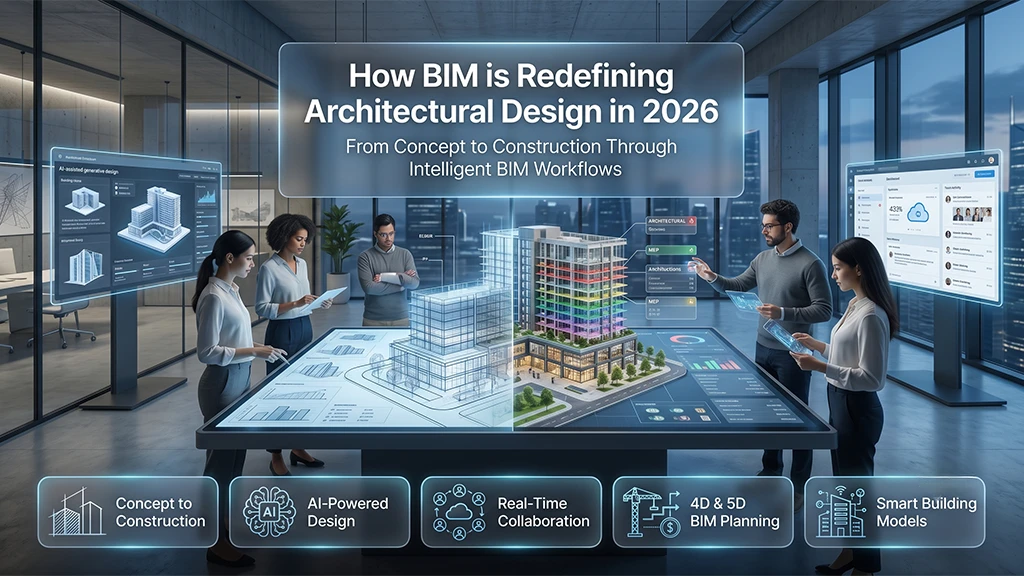
The architecture, engineering, and construction (AEC) industry is going through a seismic digital transformation, and Building Information Modeling (BIM). As projects get more intricate, the need for efficient, greener, and clearer project delivery is rising rapidly. By 2026, BIM for Architects isn’t just some optional design instrument anymore; it’s becoming a standard delivery framework that ties together each stage of the building process. From rough concept sketches to design planning, right up to field execution, BIM architectural design 2026 is reshaping how buildings get imagined, mapped, drafted, and built.
What is BIM and Why It Matters in 2026?
Building Information Modelling BIM is basically a digital process that smartly creates those intelligent, data-rich 3D models for buildings. Each 3D model that comes out of BIM includes all the data you would normally see in CAD drawings, like the building dimensions, the exact location, the type of materials used for the construction, plus the budget for the project, and also the project timing schedule. So, it’s not true that every wall, beam, pipe, or window is just a “shape”; instead, it’s more like a smart entity with properties and dependencies and even lifecycle information that gets carried along.
In 2026, BIM has improved significantly due to the implementation of cloud-based technology, the introduction of computer-assisted design or AI-aided modelling, and a wide range of real-time collaborative design tools. This has made BIM easier to use for firms of almost any size. As a result, construction projects get completed with fewer errors, faster project completion, and the buildings made with BIM are prepared to be better from the very start of the construction project.
For architectural firms like Designheed, leaning on BIM is a central thing to deliver precision-led, client-focused design outcomes across residential, commercial, and institutional projects.

BIM Across the Design-to-Construction Lifecycle
Here are the essential steps for the design-to-construction lifecycle:
1. Concept and Schematic Design – Concept and Schematic Design is where BIM really begins, at the earliest stage, and it basically sets the pace. Architects often lean on massing models to think through volumes, orientations, and those spatial ties, before they lock themselves into one single direction. With tools such as Autodesk Revit, ArchiCAD, and Navisworks, design teams can move quickly and revise again and again. It can feel almost reflexive, like nobody is overthinking it for too long.
In 2026, generative design that’s powered by AI will have been folded into BIM workflows. Architects at firms like Designheed can lay down constraints such as budget limits, floor area ratio targets, and natural lighting requirements. That helps early-stage decisions, and it also gives clients more meaningful choices to look at instead of just one almost-final concept.
2. Design Development and Documentation – When a design concept is approved, detailed architectural building information modeling begins. The building information modeling (BIM) becomes more detailed with walls having U-values, windows having performance specifications, and floors having load data. This level of detail allows structural engineers, mechanical, electrical, and plumbing (MEP) consultants, and interior designers to all work collaboratively on a common/shared BIM model at the same time.
At Designheed, we have utilized federated BIM models to allow for the seamless coordination of multidisciplinary teams during the architectural design process to ensure that the design intent is accurately depicted in the technical documentation.
3. Construction Planning and Site Execution – The 4D BIM software adds a 4th dimension of time, linking model elements with construction schedules so that project management can visualize the construction of buildings as they will actually be constructed by sequence.
The 5D BIM software has been developed to go one step further, attaching cost information to elements in the model so that project managers can view live takeoffs and track budgets.
In 2026, the use of BIM-enabled construction will also overlap with prefabrication and modular building. Basically, components are planned inside the BIM model, and then manufactured off-site using machine-level accuracy. That usually cuts down on-site waste, speeds up construction timelines, and gives steadier quality control, and yeah, those results really matter a lot for sustainable architecture.
BIM in Architecture in India: A Growing Imperative
The adoption of BIM in architecture in India has had an exponential increase over the last three years. The Government of India has rolled out the National Infrastructure Pipeline (NIP), which includes mandates for BIM usage in certain public sector projects. These initiatives have created a lot of momentum for BIM in architecture in India.
The architecture industry in India is also responding to increased global demand for BIM. International clients, commercial developers oriented toward exporting their products and services, and smart cities are all requiring projects to use BIM-compliant products and services. Companies that are not ready to use BIM will be at risk of missing out on significant tendering or bidding opportunities.
Overall, BIM adoption is greatest within Tier 1 cities (Mumbai, Bengaluru, Hyderabad, and Delhi NCR), but mid-sized firms and practices in Tier 2 cities are also gradually adopting BIM. This is being facilitated by an increase in the availability of cloud-based BIM tools that require less investment in terms of hardware.
For firms such as Designheed, who operate in a globally connected environment with clients and consultants across different countries, having proficiency with BIM is expected as the norm. Designheed’s BIM workflow allows it to work collaboratively with its international project partners, meet compliance obligations, and produce documentation that meets the rigorous review standards of its stakeholders.

Key Benefits of BIM for Architects in 2026
- Enhanced Design Accuracy Parametric technology is what makes BIM models possible, as each part of a building is defined by its respective parameter; all other related parts automatically adjust as and when any change to its parameters occurs. The result is that the inconsistencies associated with traditional 2D design drawings are eliminated and potential design errors are greatly reduced.
- Better Client Communication Photorealistic visual presentations, animated walkthroughs, and real-time shadow studies produced from the use of BIM models enable clients to gain a complete perspective of a design before any construction is undertaken. Designheed provides clients with these tools to create high-impact presentations that build trust and reduce design revision cycles.
- Sustainable Design Integration Energy modelling tools offered through BIM platforms give architects and engineers the means to simulate the performance of a building (i.e., HVAC load, cooling load, daylighting) throughout the entire design process. This capability is important for those who intend to apply for a green certification (i.e., GRIHA, LEED, IGBC, etc.) as more property developers in India are looking to develop projects that are environmentally conscious.
- Streamlined Approvals and Compliance Many states in India have accepted the use of BIM-ready files for building permit applications; therefore, digital building permit applications will be processed more quickly, with built-in traceability options, and with fewer opportunities for delayed processing using the supporting accurate BIM documentation.
- Post-Construction Facility Management BIM models will not be decommissioned once construction is completed; instead, the facility manager will continue to rely on the model for all maintenance planning, asset tracking, and future renovations. This extended lifecycle value is one of the key advantages that Designheed shares with property owners to increase their real estate investment value.
Conclusion
By the end of 2026, BIM will kind of revolutionise architectural design, since it lets architects connect design with co-ordination, construction, and facility management into one single digital ecosystem, altogether. As BIM keeps expanding across India, the organisations that lean into BIM-driven workflows can end up with higher efficiencies, better teamwork, and stronger project success chances.
If you’re interested in improving your architectural projects through the use of BIM, then Designheed provides Architects/AEC professionals with advanced BIM solutions to enable them to deliver better results from projects.
Read More – BIM for Facility Management
Frequently Asked Questions
What is BIM in architecture?
BIM in architecture is basically a digital process that builds smart 3D building models, where design details connect with construction and operation data, too. So instead of only drawings on paper, you get a model that can hold all the related information.
Why is BIM important for architects in 2026?
It helps with collaboration, makes visualization clearer, boosts project accuracy, and overall speeds up the project efficiency, while at the same time lowering design and construction risks too.
How does BIM improve construction projects?
BIM helps with clash detection, improves coordination, gives more accurate documentation, and makes project planning feel more efficient and manageable.
What are the benefits of BIM in architecture in India?
There are several advantages of using BIM to increase the efficiency of the project process in India, which include the ability to complete projects faster and at a lower cost, improve team collaboration, and support sustainable design objectives.
How can Designheed help with BIM implementation?
Designheed enables companies to better implement and deliver BIM throughout their organization by providing them with the necessary capability for both modeling & designing the project and providing effective support to the project’s completion process.