
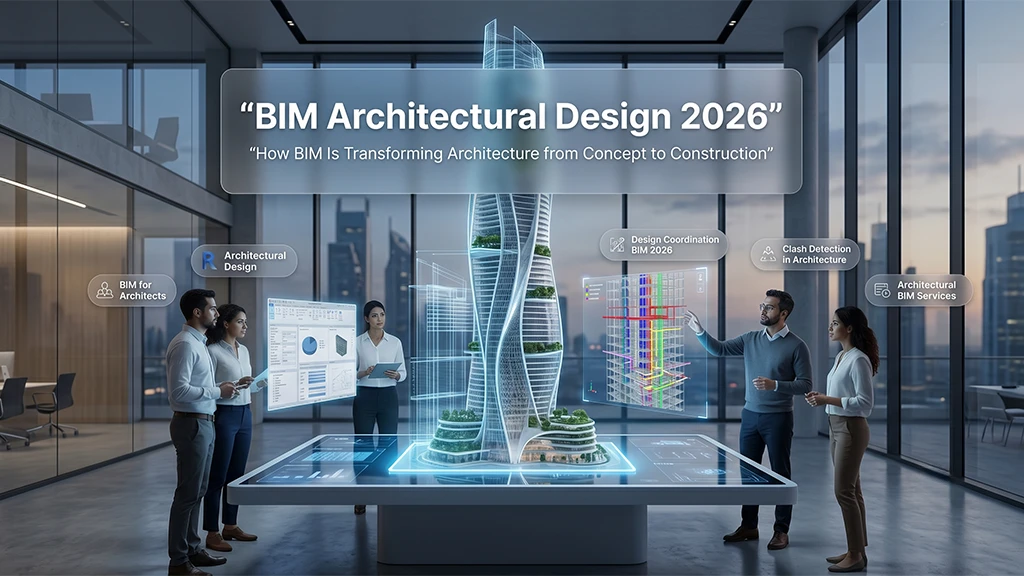
Architecture, engineering, and construction (AEC) industries have embraced digital technologies as never before. BIM architectural design has been the core force of these advancements as complexity in construction projects continues to surge, client demands ascend, and architects utilise these advanced BIM solutions in their practices. Designers use BIM to optimise workflows and deliver smarter, more sustainable, and collaborative projects.
Since the beginning of 2026, BIM has become the central building Information modeling to represent the digital lifecycle of a project from beginning to end. Architects utilise these methods and tools, such as those offered at Designheed, to manage and design all stages of a building’s lifecycle, including planning, Construction, and operation. Building Information Modelling is redefining architectural design today and for the future.
Transformation From 2D Drawings to Intelligent 3D Models
For decades, architectural work relied on stacked 2D drawings, plans, elevations, and sections that often required manual cross-checking for consistency. BIM for architects changes this whole pattern by swapping those static pages for a single intelligent 3D model, where geometry, materials, performance data, and even scheduling.
So, if a wall shifts inside the floor plan, then the section, elevation, and the schedule also update automatically. For firms like Designheed, this is not only a time saver, but it also works like a quiet quality gate. Stuff that used to show up during construction, and cost lakhs to repair, is now found earlier at the design phase, where adjustments are cheap, and they happen quickly too.

BIM Architectural Design 2026
So, what makes BIM architectural design 2026 feel different from BIM practices five years ago? A few trends really show up, and they do not just sit there. Here are those few trends that standout:
- AI-assisted Modelling: Generative design tools, now tied into Revit, can actually suggest massing options; they can also fine-tune floor plates for daylight, and they can even do early performance checks in minutes, not days.
- Cloud-native Collaboration: Common Data Environments (CDEs) such as Autodesk Forma have matured a lot, so real-time, multi-disciplinary teamwork is easier now across different time zones and geographies.
- Deeper Interoperability: Open BIM standards (IFC, COBie, BCF) are more broadly used, which means architects, structural engineers, and MEP consultants can trade data smoothly even if each team is working in different tools or slightly different pipelines.
- ISO 19650 as the Norm: What used to be “a nice-to-have” certification is now more often written as a contractual expectation, especially for institutional or government-driven projects.
For practices operating in India, these shifts matter a bit more than elsewhere, and that leads us to the local context.
BIM in Architecture India: A Market on the Move
So BIM in architecture India has, lik really picked up speed in the last few years. The push comes from big infrastructure efforts , government rules that lean toward digital documentation, and a growing number of international clients who kind of expect BIM-based outputs as the new norm.
Many Indian architecture firms used CAD-heavy workflows and are now shifting towards architectural BIM services. It’s not only about staying competitive on tenders, but also because clients are now looking very specifically for federated models, clash reports, and 4D construction sequencing as part of what they receive. Designheed has tried to get ahead of that change by building internal capacity, with BIM proficient teams that can move pretty smoothly from design intent into usable constructible documentation, without all the usual friction.
This matters a lot for commercial work and high-rise projects, as the coordination load is huge. When architecture, structure, and MEP are all interacting across dozens of floors, manual coordination becomes almost unmanageable.

Revit Architectural Design: The Backbone of Modern Practice
On the software side, Revit architectural design still feels like the dominant platform for BIM-based work, and honestly, for a reason. Revit lets architects:
- Build parametric families for walls, doors, windows, and other custom components that match what the project actually needs
- Run worksets for big teams, so everyone can work on the same model together at the same time
- Develop coordinated sheet sets, schedules, and quantity takeoffs right from the model itself
- Do massing studies and environmental analysis early on, before things get too far
What makes Revit especially strong in 2026 is how well it connects with third-party tools like Enscape for live visualisation, DiRoots for documentation automation, and MagiCAD for MEP coordination. All of it plugs into the same central model, so the workflow stays consistent, even when tasks change. For Designheed’s design teams, this turns into less time wrestling with repetitive paperwork and more time dealing with real design problems, you know, those that actually matter.
BIM Design Coordination & Clash Detection in Architecture
Perhaps the single biggest value driver of BIM is BIM design coordination, the process of merging architectural, structural, and MEP models into a federated model to identify conflicts before construction begins.
Clash detection in architecture has traditionally been one of the most time-consuming and error-prone aspects of project delivery. A ductwork run that collides with a structural beam, or a sprinkler line that intersects a ceiling soffit, can cause costly delays and rework if discovered on-site. Using tools like Navisworks, BIM teams can now run automated clash tests across the entire federated model, categorise issues as hard or soft clashes, and resolve them digitally long before the first brick is laid.
This is where a well-structured BIM workflow architecture firm truly differentiates itself. It’s not enough to simply model in 3D; the workflow needs to include regular coordination meetings, issue tracking via BCF, and a clear protocol for resolving conflicts between disciplines. Designheed’s project delivery process builds these coordination checkpoints into every phase, ensuring that design coordination BIM 2026 isn’t an afterthought, but a core part of how projects move from concept to construction.
BIM Modelling for Architects India: Building the right skill set
Conclusion
BIM has moved from being a documentation tool to becoming the central nervous system of architectural practice. From early-stage massing and performance analysis to detailed coordination and construction sequencing, BIM architectural design now touches every phase of a project’s life.
For firms like Designheed operating in India’s fast-evolving architecture market, embracing BIM isn’t just about staying current; it’s about delivering better-coordinated, lower-risk, and more efficient projects for clients who increasingly expect nothing less.
Read More – How BIM is Redefining Architectural Design in 2026
Frequently Asked Questions
What is BIM architectural design?
BIM architectural design refers to the development of advanced 3D models of buildings that include all relevant information about the building’s geometry, data, and construction documentation in a single format.
Why is BIM important for architects in 2026?
BIM will support architects with increased collaboration, accuracy of design, and efficiency on the project, with fewer chances for costly errors that require rework.
How does clash detection work in architecture?
In architecture, clash detection allows the architect to see any potential problems between the architectural, structural, and MEP systems before construction starts.
What software is commonly used for BIM architectural design?
Autodesk Revit is the most widely used software program for creating BIM models, as well as providing contractor documentation and creating design coordination.
How is BIM transforming architecture in India?
BIM is enabling architecture firms in India to continue to produce projects promptly, with improved coordination, while also meeting all of the international construction standards.
What are architectural BIM services?
Architectural BIM services include all aspects of BIM, including modelling, drafting, visualisation, clash detection, and contractor documentation support.
What are the benefits of BIM design coordination?
BIM design coordination allows for better collaboration among project participants, reduced design conflicts, and improved delivery of the project.