
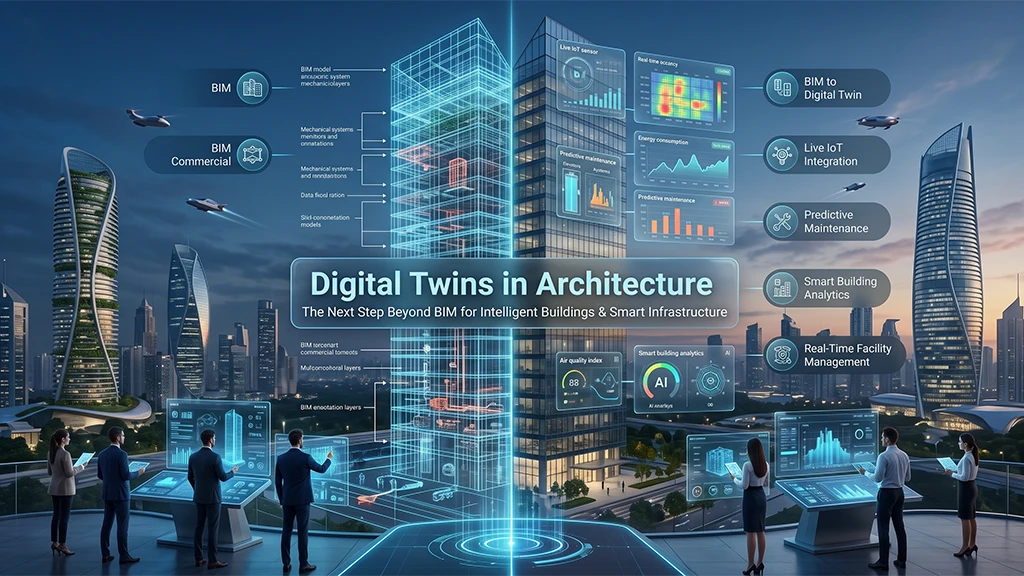
Beyond BIM, the digital landscape has drastically changed throughout the AEC industry. Architectural design is no longer just constrained by the static 3D representation of the project as the BIM to digital twin transition takes place. This transition represents a revolutionary development for construction, facility management, and real estate throughout the world. Designheed’s innovative use of sophisticated spatial engineering and data-driven workflows will help ensure project success in the future of global infrastructure.
At Designheed, this is not just an upgrade; instead, it is the next generation of technology. While BIM represents the external design elements of a building, the creation of digital twins represents the actual functioning and use of the building.
What is a Digital Twin in Architecture?
A digital twin is essentially an identical copy of the physical building’s design. Digital twins utilize IoT (Internet of Things) sensors or other methods to create a live link to the physical asset and display that information on a digital dashboard. This capability gives architects access to new capabilities for analyzing, monitoring, and simulating their building’s structure and performance over its lifecycle.

What are the Benefits of Digital Twin in Architecture?
Some of the core benefits of the digital twin in architecture include:
- Real-Time Building Monitoring Real-time monitoring of building use through a building digital twin architecture integrated with Internet of Things (IoT) enables an organization to respond quickly to operational issues, leading to improved efficiency and performance of buildings.
- Better Design Accuracy and Collaboration BIM digital twin India enhances collaboration across all architects, engineers, contractors, and project owners, providing transparent data throughout the construction process.
- Predictive Maintenance – Digital Twin enables the architectural team to maintain and predict system failure, such as HVAC malfunction or other systems, to avoid costly rework.
- Energy Optimisation Using tools like AutoDesk prepares buildings for sustainable energy by simulating real-time energy usage, lighting, and thermal performance.
- Enhanced Construction Planning Digital twin construction 2026 helps contractors monitor project progress and enhances the construction planning process that leads to:
- Better project scheduling
- Improved resource allocation
- Fewer construction delays
- Enhanced worker safety
With the increasing adoption of BIM digital twins in India, top companies such as Designheed are moving beyond static models toward intelligent, data-driven buildings.
What are the types of digital twins?
Digital twins are digital representations of physical assets, systems, or processes. The main types of digital twins include
- Component Twins,
- Asset Twins,
- System or Unit Twins,
- Process Twins
These represent individual components, complete assets, interconnected systems, and entire operational processes, enabling real-time monitoring, analysis, and performance optimization.

What is the Difference Between BIM and Digital Twin?
Here is a comprehensive overview and comparison between Building Information Modelling (BIM) and Digital Twins (DTs), along with their key differences and similarities in capabilities:
Feature | Building Information Modelling (BIM) | Digital Twin |
Core Concept | A static, 3D object-oriented model containing intelligent physical and functional data of a building. | A living, digital counterpart of a physical asset that changes dynamically with real-time data feeds. |
Data Nature | Reflects the design intent of the building, blueprints, and the structural parameters. | Reflects the current operational reality or real-time data and the immediate state of the physical asset. |
Primary Data Source | Architectural software, CAD inputs, material specifications, and engineering data. | Internet of Things (IoT) sensors, SCADA systems, operational tech, and environmental feeds. |
Direction of Data Flow | Data is designed or scanned into the model to construct or document the asset. It is a one-way data flow. | Data travels from the asset to the twin (monitoring function) and from the twin to the asset (control/automation). This means there is a two-way data flow between the two systems. |
Primary Focus Lifecycle | Highly critical during the Design and Construction phases of a project. | Highly critical during the Operations, Maintenance, and Management phases. |
Predictive Capabilities | Can locate structural conflicts before the construction of a building, but BIM cannot foresee operational failure until it has occurred. | AI and machine learning will help with predictive maintenance, preparing for potential breakdowns of equipment (failures) and energy spikes. |
Scope of Application | Limited to the specific structure/building boundary as designed. | Beyond the building to encompass entire smart cities, logistics networks, or electric power grids. |
What Next After BIM in Digital Twin in Architecture?
Real-time data integration is an important next step when moving from the implementation of Building Information Modeling (BIM) into the architectural digital twin. After integrating the static geometrical (3D) and semantic data of BIM, the next step in creating a real-time architecture digital twin is to connect the BIM building model to the actual building using IoT sensors, Building Management Systems (BMS), and Artificial Intelligence (AI) for continuous and dynamic building monitoring.
The transition from the static BIM model to an operational digital twin consists of three primary advancements:
- Integration Layer (IoT & Sensor Mappings)
- Provides buildings with IoT sensors that provide live operational data such as occupancy, temperature, and energy consumption.
- Continuous transmissions of data from these sensors via APIs are used to create real-time mapping of operational parameters onto 3D BIM models.
- AI & Predictive Analytics
- Transitioning to performance prediction from basic monitoring can occur through integrating AI into BIM and DT.
- AI uses both historical and real-time data to predict maintenance issues, optimize energy usage, and control mechanical systems automatically.
- Bidirectional Feedback Control
- Creates two-way feedback loops between the physical structure and the BIM or two dimensional Model of that structure.
- Enables two-way synchronization of changes to the physical building with the digital building models (Building Information Model [BIM]) and vice versa.
- Advanced Visualization & Metaverse
- Digital twins can now be used in AR, VR, and Mixed Reality environments for immersive, collaborative design projects across borders.
- Dramatically enhances interaction between humans and computers while providing an interactive 3D environment for virtual presentations of remote building design reviews.
Conclusion
Intelligent, connected environments are crucial to the future of architectural design. In addition to helping architects visualize a building before construction begins through Building Information Modeling (BIM), Digital Twin architecture uses data to provide real-time insights and prognostics for a building’s entire lifecycle.
The rapid pace of digital transformation in India requires all businesses to leverage digital twin technology to prepare for the future. With Designheed’s expertise in cutting-edge BIM innovation, we help businesses seamlessly transition to a smarter, more efficient, and sustainable built environment.
Frequently Asked Questions
How does a digital twin differ from a traditional BIM model?
A digital twin integrates live, real-time data feeds such as sensor-based IoT technology to reflect the present operational state of the building. A traditional BIM provides the design and physical structure of a building.
Can existing BIM workflows be upgraded to digital twins?
Yes, the transition from BIM to digital twin architecture is a natural development. Designheed can add IOT sensors, ongoing operational data, and cloud connectivity to create an intelligent digital twin from existing legacy assets.
What are the cost benefits of implementing a digital twin in facility management?
A digital twin significantly reduces operational and maintenance costs by enabling predictive maintenance programs, optimizing energy consumption, and extending the building’s overall lifecycle.
Why is digital twin technology becoming popular in India?
The adoption of BIM digital twin solutions drives infrastructure development, growth in smart city initiatives, and demand for intelligent buildings.